ADVERTISEMENT
Early Polling: A Close Contest?
Even without official nominations, early polls offer a snapshot of how a Newsom‑Vance matchup might play out.
On the Republican side, Emerson College polling indicates Vance holds significant support among GOP voters, often outpacing rivals like Ron DeSantis or Marco Rubio by wide margins.
Such early numbers don’t guarantee a final result—especially in America’s decentralized primary system—but they amplify a critical point: both candidates have real constituencies that could propel them toward their party’s nomination.
The Narrative Factor: Personality, Image, and Voters’ Emotions
Numbers tell part of the story—but personality and perception drive campaigns.
Newsom: The Charismatic Progressive
Newsom’s political style blends flamboyance with strategic messaging. He has built a reputation for being a media‑savvy communicator and a defender of progressive causes. His statesmanlike presence in international forums like Davos has been interpreted as an attempt to project national stature and readiness for higher office.
But that same visibility has attracted critiques—from within his party and outside of it. Prominent Democratic strategist David Axelrod recently criticized Newsom for being self‑promotional, reflecting internal debates about his suitability as a national leader.
Newsom’s image also plays differently in various parts of the country. While he may resonate with progressive and urban voters, some swing‑state and rural voters view him as emblematic of coastal liberalism—a label that can often be weaponized in national debates.
J.D. Vance’s appeal centers on his narrative as a cultural conservative with working‑class roots. His brand draws on themes of authenticity, skepticism toward elite institutions, and an emphasis on traditional American values—positions that align with much of the Republican base.
In prediction markets and GOP polling, Vance’s early lead reflects a broader appetite among Republican voters for candidates who can speak directly to cultural anxieties and economic discontent.
However, Vance’s conservative positioning might limit his appeal among moderate and independent voters—critical constituencies in general elections. How well he can broaden his reach beyond the Republican core will shape his competitiveness in a national contest.
Policy Contrasts: What a Newsom–Vance Race Might Look Like
A hypothetical 2028 showdown between Newsom and Vance would underscore stark policy divides:
On the Economy
Newsom: Likely to emphasize progressive economic reforms, expanding social safety nets, and addressing income inequality.
On Cultural and Social Issues
Newsom: Advocates for expansive healthcare, climate action, and inclusive social policies.
Vance: Emphasizes traditional values, critiques of progressive cultural shifts, and policies appealing to cultural conservatives.
On Governance and Federal Strategy
Newsom: Could argue for stronger federal leadership on national issues.
Vance: Might push for decentralization, states’ rights, and conservative judicial appointments.
These broad differences reflect the larger ideological divide in American politics—a divide that would animate debates, media coverage, and voter mobilization in the lead‑up to 2028.
Uncertainties and the Long Road Ahead
Despite all the talk, significant uncertainty remains:
Official Candidacies: Neither Newsom nor Vance has formally clinched their party’s nomination.
Primary Dynamics: Both parties are still likely to experience competitive primaries with potential dark horses or shifts in voter sentiment. For Democrats, figures like Alexandria Ocasio‑Cortez or current leaders could reshape the field.
External Events: Global and domestic developments—economic shifts, foreign policy crises, social movements—could dramatically alter the political conversation by 2028.
Strategic Considerations for Both Camps
For Newsom
Unify the Democratic Base: Balancing progressive demands with broader appeal will be crucial.
Address Critiques: Internal party critics could shape debates about electability, requiring strategic messaging.
National Visibility: Continuing to build a national profile beyond California will matter for fundraising and recognition.
For Vance
Expand Beyond the Base: To win a general election, broadening his message to include moderate and independent voters will be key.
Navigate Republican Factionalism: The GOP remains diverse in ideology; consolidating early support matters.
Counter Democratic Framings: In a polarized environment, effective rebuttals to progressive narratives will be central.
Why This Matters: The Stakes of 2028
This potential matchup is not just about individual personalities—it reflects deeper questions about the direction of American democracy:
Will voters favor continuity or change?
Are cultural messages or policy visions more persuasive?
How will shifting demographics shape outcomes?
Can a nominee appeal across regional divides?
A 2028 Newsom–Vance contest would symbolize a broader confrontation between two competing visions of governance and society. It’s a reminder that presidential politics are always about more than personalities; they’re about the choices a nation makes about its future.
Final Thoughts
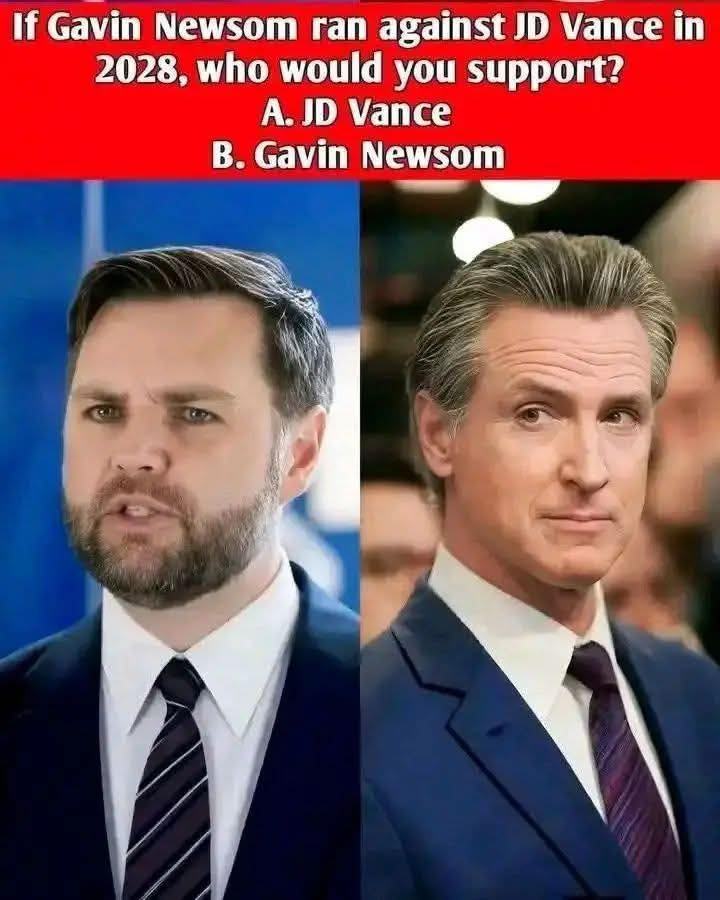
The idea of a 2028 showdown between Gavin Newsom and J.D. Vance is still early—but already significant. Through polling, prediction markets, and evolving political narratives, both figures are among the candidates shaping expectations for the next presidential cycle.
Whether it happens or not, the discussion around such a race highlights the deep divisions, emerging coalitions, and urgent questions at the heart of American politics. In an era of intense polarization and rapid change, the 2028 election—real or hypothetical—is already a defining moment in the nation’s political imagination.
ADVERTISEMENT
